Unfortunately, I've had trouble trying to get line tests done over the Easter break due to a lack of access to the animation studio. I did manage to do a very short test using my digital camera, which seems to be at the speed and accuracy that I want, but I'm still unsure of the rest of the film. I'm hoping that my instincts are correct in the drawings though and I won't need to make any adjustments. This section is of the fibonacci spiral transforming into a galaxy.
Wednesday, 23 April 2014

Tuesday, 22 April 2014
Printing patterns

 In order to get every element of a mandala the same, it makes sense to use a printing technique. Obviously with printing, there is always an aspect of difference between each print, depending on how the paint/ink has connected with the printing block and then the surface. I did some experimenting with found objects such as jewellery, pins, charms, coins and pen lids.
I also tried printing leaves but the effects were so different each time that I didn't think they'd make good prints for mandalas. Other people have used leaves to create natural mandalas though by using the entire leaf rather than just an imprint of it.

Bunnies and Buddhism
 I love rabbits, having always owned them as pets; and I think their movement is fantastic for animations, as it's such a fluid, joyful motion. I wanted to somehow include my love of these little creatures in my animations, and discovered that Fibonacci came up with a hypothetical situation involving rabbit breeding habits, which followed his mathematical sequence.
 Until now however this only allowed me the possibility of including bunnies in one of the films. After some further research into shape symbolism in Buddhism and other religions/cultures, I found these images of Buddhist and Celtic triskelions.
 I may not include these in the final films as there is already a lot of imagery and content relating to my subject, but for my own personal interest, I'm really pleased to have discovered these quirky little images. They are especially interesting to me as I have Irish celtic roots as well.
Friday, 11 April 2014
Animation #2
 My second film in this project is going to be based around the Buddhist theories of order and balance in the universe, as a contrast to the mathematical Fibonacci theory. Although they overlap in certain areas, I want my second film to be more like a celebration than a deconstruction of the universe. To acheive this I've been looking at mandala patterns and filming techniques that use natural processes to create beautiful images, such as inks seeping through water. This film is going to be more simplistic than my hand-drawn animation; it will just use symmetry and movement to produce balanced, and hopefully beautiful, visual representation of the ideas of cosmic forces.
I may also delve into the idea of chakras and healing forces, which will hopefully mirror my Fibonacci video and the idea of the sequence being present in the human form (Da Vinci's Vetruvian Man). I will try to time my videos so that they run simultaneously and reflect both sides of the same question about the divining powers of the universe: is it a purely mathematical structure or unknown karmic forces which keep the universe revolving?
Tuesday, 8 April 2014
How to draw a galaxy...
My animation design has meant that I have set myself the challenge of drawing and animating a galaxy. Having never even attempted to draw a galaxy before this was probably not the brightest idea I've had so far in this project, however it seems necessary in order to visually explain the theory of pantheism (that life on Earth originated from a single organism transported to Earth by a meteorite). In my animation it is, of course, a spiral-covered, Fibonacci-infused meteorite in order to create a planet full of life forms exhibiting the Fibonacci pattern... makes sense right? And equally logically, this meteorite needed to come from a Fibonacci galaxy.
 So, how to draw a galaxy?
I needed the design to be fairly quick and simple to reproduce, otherwise the animating would take far too long for the schedule I'm running to (approx. 24 frames a day currently).
My original designs consisted of a few quick line in pen in a vague spiral form... not very inspiring, beautiful or scientific.
I then began to mess around by smudging the inks, but it still wasn't achieving the magical, beautiful look I was after. I decided that in order to get the desired effect, I'd need to add some sparkle and colour, so I invested in gold, cobalt and magenta inks to experiment with.
I kept the strong black lines though too, as I want them to be a stable feature throughout the film.
Having not done a line test yet on the animation though, I am still to see if this technique works the way I want it to. I may, for example need to adjust the lighting so that the gold is picked up properly by the camera. At the moment though, I'm happy with the images I'm producing and think they hold the gaze.
So, how to draw a galaxy? I needed the design to be fairly quick and simple to reproduce, otherwise the animating would take far too long for the schedule I'm running to (approx. 24 frames a day currently).
My original designs consisted of a few quick line in pen in a vague spiral form... not very inspiring, beautiful or scientific.
I then began to mess around by smudging the inks, but it still wasn't achieving the magical, beautiful look I was after. I decided that in order to get the desired effect, I'd need to add some sparkle and colour, so I invested in gold, cobalt and magenta inks to experiment with.
I kept the strong black lines though too, as I want them to be a stable feature throughout the film.
Having not done a line test yet on the animation though, I am still to see if this technique works the way I want it to. I may, for example need to adjust the lighting so that the gold is picked up properly by the camera. At the moment though, I'm happy with the images I'm producing and think they hold the gaze.
Alternative Mandalas

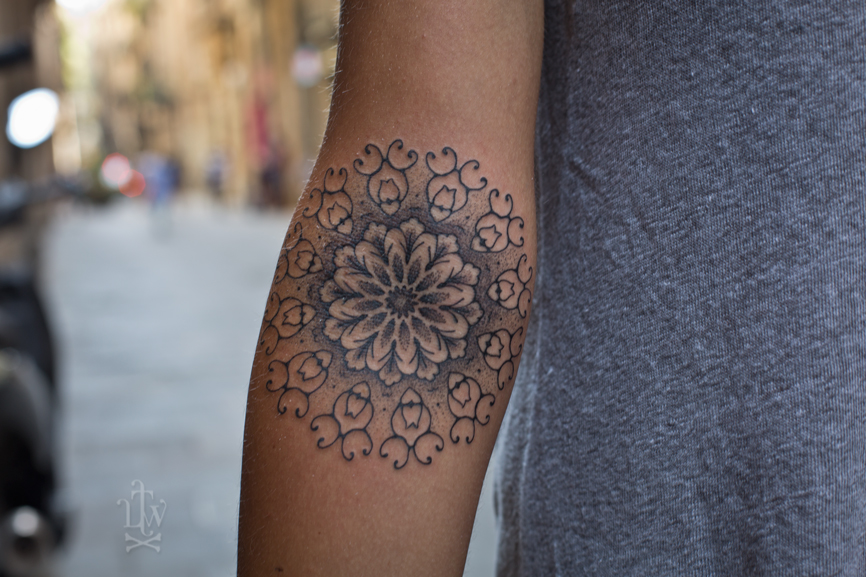 Since researching the historical and spiritual aspects behind the mandala pattern, I've been taking into account how people subvert symbols from other cultures for use in their own, sometimes losing the message along the way. For example, mandala patterns are now very commonly used for tattoo designs, but as the idea has become more prevalent, the mandala form has evolved. This is perhaps due to tattoo designers becoming more and more ambitious and competitive with each other, and thereby creating more complex designs, rather than adhering to the traditional 4-cornered Buddhist mandala. Mandala designs are more intricate and floral, taking aspects from Indian paisleys and henna patterns, Aztec geometrics and natural forms. As these are permanent fixtures to the human body, they disregard the Buddhist tradition of destroying the mandala once it is complete. Instead they often focus on the harmony of the design, its symmetry and beauty reflecting body, mind and spirit combined.
  After considering how the mandala has changed subject to culture and time, I decided to again reinvent the mandala by creating a design whilst cooking. I made a pizza mandala, which disregards all aspects of traditional and contemporary mandala, and instead shows the impermanence of things. The design changed first when the pizza was cooked and then was destroyed by being sliced up and eaten.
Thursday, 3 April 2014
Papercraft Animations
My research into origami and papercraft has led me to paper-cutting in animation. As paper is such a versatile material, it can be used to create 3D stop-motion animations, because it both holds its shape and can be easily manipulated into new positions/forms. The best examples so far that I've come across are those by Andersen M Studio, who make short promotional animations for books, TV series and websites. My favourites are either the promotional video for the novel, 'The Distant Hours' or the advert for a new Discovery Channel TV show, 'Shackleton: Death or Glory'.
The Distant Hours video was beautiful because it used only basic materials of paper and dirt, but the lighting, sound and camera angles of the film made it into a short drama, filled with tension and intrigue. The juxtaposition of harsh straight edges and the curving lines of flowers also made it a beautiful film to watch, and attests to the wonderful combinations of shapes that can be achieved with just paper.
The Shackleton film appealed to me because of the connection between the materials used and the subject matter. The animators used nautical maps of the southern polar regions to create a ship and waterscape scene based around Shackleton's journey to Antarctica.
After seeing these gorgeous animations, I'd really love to combine paper-cutting into my 2nd film based around mandalas, pattern-making and balance. I think because of time limitations and because I've never done a paper stop-motion before, I will probably keep the film quite simple. Perhaps just spinning mandala patterns overlapping and intertwining for one scene of the film before they fold into an origami shape for example.
Subscribe to:
Posts (Atom)