Tuesday, 8 April 2014

How to draw a galaxy...

My animation design has meant that I have set myself the challenge of drawing and animating a galaxy. Having never even attempted to draw a galaxy before this was probably not the brightest idea I've had so far in this project, however it seems necessary in order to visually explain the theory of pantheism (that life on Earth originated from a single organism transported to Earth by a meteorite). In my animation it is, of course, a spiral-covered, Fibonacci-infused meteorite in order to create a planet full of life forms exhibiting the Fibonacci pattern... makes sense right? And equally logically, this meteorite needed to come from a Fibonacci galaxy.

So, how to draw a galaxy? 
I needed the design to be fairly quick and simple to reproduce, otherwise the animating would take far too long for the schedule I'm running to (approx. 24 frames a day currently). 
My original designs consisted of a few quick line in pen in a vague spiral form... not very inspiring, beautiful or scientific. 
I then began to mess around by smudging the inks, but it still wasn't achieving the magical, beautiful look I was after. I decided that in order to get the desired effect, I'd need to add some sparkle and colour, so I invested in gold, cobalt and magenta inks to experiment with. 
I kept the strong black lines though too, as I want them to be a stable feature throughout the film. 
Having not done a line test yet on the animation though, I am still to see if this technique works the way I want it to. I may, for example need to adjust the lighting so that the gold is picked up properly by the camera. At the moment though, I'm happy with the images I'm producing and think they hold the gaze. 


Alternative Mandalas


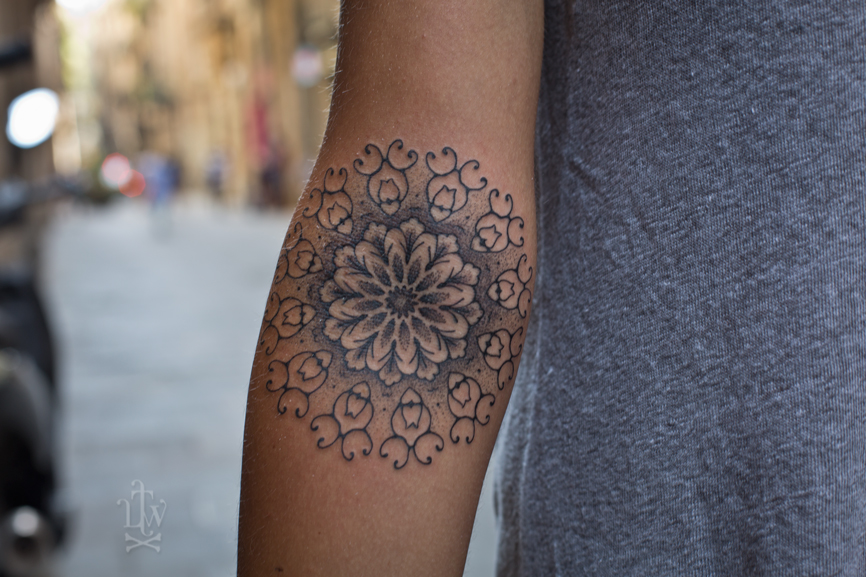
Since researching the historical and spiritual aspects behind the mandala pattern, I've been taking into account how people subvert symbols from other cultures for use in their own, sometimes losing the message along the way. For example, mandala patterns are now very commonly used for tattoo designs, but as the idea has become more prevalent, the mandala form has evolved. This is perhaps due to tattoo designers becoming more and more ambitious and competitive with each other, and thereby creating more complex designs, rather than adhering to the traditional 4-cornered Buddhist mandala. Mandala designs are more intricate and floral, taking aspects from Indian paisleys and henna patterns, Aztec geometrics and natural forms. As these are permanent fixtures to the human body, they disregard the Buddhist tradition of destroying the mandala once it is complete. Instead they often focus on the harmony of the design, its symmetry and beauty reflecting body, mind and spirit combined. 
After considering how the mandala has changed subject to culture and time, I decided to again reinvent the mandala by creating a design whilst cooking. I made a pizza mandala, which disregards all aspects of traditional and contemporary mandala, and instead shows the impermanence of things. The design changed first when the pizza was cooked and then was destroyed by being sliced up and eaten.

Thursday, 3 April 2014

Papercraft Animations

My research into origami and papercraft has led me to paper-cutting in animation. As paper is such a versatile material, it can be used to create 3D stop-motion animations, because it both holds its shape and can be easily manipulated into new positions/forms. The best examples so far that I've come across are those by Andersen M Studio, who make short promotional animations for books, TV series and websites. My favourites are either the promotional video for the novel, 'The Distant Hours' or the advert for a new Discovery Channel TV show, 'Shackleton: Death or Glory'.

The Distant Hours video was beautiful because it used only basic materials of paper and dirt, but the lighting, sound and camera angles of the film made it into a short drama, filled with tension and intrigue. The juxtaposition of harsh straight edges and the curving lines of flowers also made it a beautiful film to watch, and attests to the wonderful combinations of shapes that can be achieved with just paper.

The Shackleton film appealed to me because of the connection between the materials used and the subject matter. The animators used nautical maps of the southern polar regions to create a ship and waterscape scene based around Shackleton's journey to Antarctica.

After seeing these gorgeous animations, I'd really love to combine paper-cutting into my 2nd film based around mandalas, pattern-making and balance. I think because of time limitations and because I've never done a paper stop-motion before, I will probably keep the film quite simple. Perhaps just spinning mandala patterns overlapping and intertwining for one scene of the film before they fold into an origami shape for example.

Monday, 31 March 2014

Light and Water Workshop

Today we did a workshop based on the effects of light shining through water, and had various materials provided to us which would create certain effects when dropped into the lit water. We used an overhead projector with clear Perspex bowls filled with water placed on top. This meant that anything dropped into the bowl of water would be projected onto a wall and enlarged. We experimented with various coloured inks, washing up liquid, coloured films, oil, prisms and magnifying glasses. We also tried different methods of delivery into the bowls of water, such as dropping inks from high up and dribbling them down the sides of the bowls. We also experimented with the effects made by blowing on the water and using a straw to create bubbles. These looked really good when reflected onto the wall, as the bubbles collected a deeper tone of ink around the edges and refract light within them. Some of the images looked like living things, such as microbes or bacteria. The oil and washing up liquid worked well with the water and inks as well because they don't mix, and so blobs of oil separate in the liquid, creating suspended islands of clarity within the inky water swirling in the bowl.
The videos we made had a very ethereal quality to them, and give an impression of balance and magic. I think therefore that this technique will be fantastic when used as a background in my 2nd film about mandalas and the Buddhist theories on the karmic balance of the universe. Other techniques I may use in this film might be pixilation and paper craft.

I attempted to make my own projections at home using a perspex tray and my lightbox, but it wouldn't project clearly enough so I just photographed the tray itself. I think they look like forming galaxies, which is very relevant to my project. 


Friday, 28 March 2014

Origami Mischeif

As I've been thinking about maths in art and the power of geometry and symmetry, a leap into the world of origami didn't seem that far a stretch. Some origami patterns share similar characteristics to mandalas; focusing around a central point, layering of shapes, symmetrical composition etc. Most people know how to make a simple origami fortune teller (a lost skill from their school days) so I thought it would be a nice little exercise to make an animation of the making of one. It was also a quick way for me to sample the new Zeitrapher app on the Macs in the animation studio. 
It's not the neatest animation as I only took photographs using my phone and did not use a tripod to keep the camera steady, but it's a jumping off point for future films. A discussion with my tutor led to the idea of using   green screen technology so the paper could be manipulated on screen without seeing my hands. This could also allow me to put further animation into the background perhaps. These little clips of origami manufacture could also be adapted by putting a kaleidoscope effect on the film to create a mandala-like image of origami structures. 

Thursday, 27 March 2014

Mandala Meanings

Merriam-Webster dictionary describes the mandala symbol as follows:


1:  a Hindu or Buddhist graphic symbol of the universe; specifically :  a circle enclosing a square with a deity on each side that is used chiefly as an aid to meditation.
2:  a graphic and often symbolic pattern usually in the form of a circle divided into four separate sections or bearing a multiple projection of an image.


In Tantric Hinduism and Buddhism (see Vajrayana), a diagram representing the universe, used in sacred rites and as an instrument of meditation. The mandala serves as a collection point for universal forces. By mentally “entering” the mandala and moving toward its centre, one is guided through the cosmic processes of disintegration and reintegration. Mandalas may be painted on paper or cloth, drawn on the ground, or fashioned of bronze or stone. Two types of mandalas represent different aspects of the universe: the garbha-dhatu (“womb world”), in which the movement is from one to the many, and the vajra-dhatu (“diamond world”), from the many into one.

This is a fairly concise and clear description of what a traditional mandala form means, however, as with most symbols, the form has been adopted by other cultures and in many circmstances it no longer holds its sacred meaning. Traditionally Buddhist monks will work on a mandala collectively (as a group of 4), and will only be allowed into the 3 year long process after they have studied artistic and philosophical practices. The process requires meditative concentration and is a balanced construction with each monk working on their own quadrant in synchronisation with the others.
The mandala is traditionally made out of coloured sands, and at the end of the lengthy process it is customary for the image to be destroyed, often by throwing the sands into a nearby stream to distribute the positive energies. This process, although it seems destructive and unfair, is to remind the monks of the important fact that everything is impermanent - a central Buddhist teaching.


Wednesday, 26 March 2014

Spirals are EVERYWHERE!

It's amazing how your subconscious focuses in on something after it's been exposed to an idea. It's the kind of phenomena that means as soon as you buy a new car or dye your hair a new colour, you start seeing the same car/hair colour everywhere you look. The simple fact is that they've probably been around you for a while and you just haven't noticed until it was relevant to your life. This is what has happened to me since I started looking at the Fibonacci series and mandala patterns. I'm now noticing spirals and patterns everywhere.
In uni last week we had a guest lecture from Brendan Dawes, who tries his hand at a variety of different mediums and styles. I really liked some of his work; his happiness machine is exactly what I think art should be, entertaining and there to make people happy. It's his work for EE however which captured my attention in relation to my project. He created a way of visualising links in Twitter over 3 days and 11 different cities as part of their promotional campaign. His final design is based on the formation of sunflower seeds on the flower, but he uses different sized and coloured dots as a code for the Tweets, which gives the effect of a sporadic mandala pattern.
I absolutely love it when data is visualised by artists, hence the reason I'm so into maths for this project. My flatmate owns a book called 'Information is Beautiful', which is a collection of innovative ways of presenting data. I think Dawes' EE Digital City Portraits could easily be a part of the book, as it has made millions of tweets digestible in just a few beautiful images. I particularly love how one of the images shows an influx of tweets from the London area regarding a hurricane in New York, and the formation of Dawes' images reflects the structure of a hurricane as it follows the same Fibonacci spiral - a lucky, unintended stroke of brilliance in the work due to the data that came through.
http://brendandawes.com/projects/ee